
What the Baha'i believe
OverviewBaha'u'llah
Baha'i Literature
Messages of the Univeral House of Justice
Compilations
What the Baha'i do
OverviewEducation
Feast
Social action
The Baha'i Faith
Spiritual Education of Children and Youth
The moral and spiritual education of children, the junior youth and the youth is a task of utmost importance to every Bahá’í community. To respond to the spiritual needs and aspirations of the young is among the primary concerns of the Bahá’ís and their institutions.
A responsibility that cannot be neglected
“Independent of the level of their education, parents are in a critical position to shape the spiritual development of their children. They should not ever underestimate their capacity to mold their children’s moral character. For they exercise indispensable influence through the home environment they consciously create by their love of God, their striving to adhere to His laws, their spirit of service to His Cause, their lack of fanaticism, and their freedom from the corrosive effects of backbiting.”
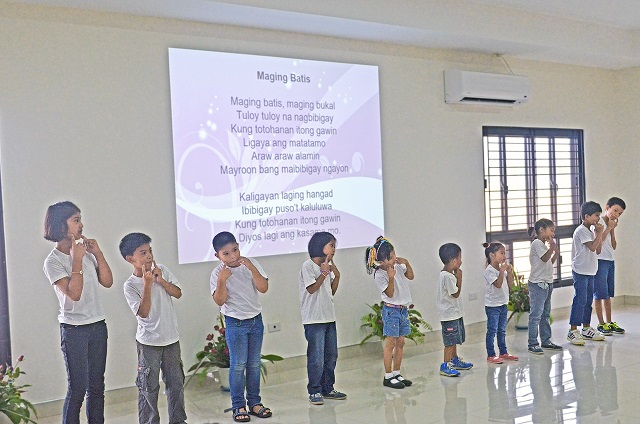
While parents play a key role in the education of their children, the community also has a great responsibility in nurturing their potential for them to grow up capable of making sound moral decisions. It is both the responsibility of the family and the community to nurture these young souls in order that they come to understand that they have a role in advancing civilization, by tending to their own spiritual growth and working with others in serving humanity.
In its effort to systematically provide moral education to the young in various neighbourhoods, the Philippine Bahá’í community adopts the courses developed by the Ruhi Institute that offer lessons to children aged 5–10 years old and a spiritual empowerment program to junior youths aged 11–14.
Children’s Classes
The lessons included in the children’s classes give emphasis to the importance of developing spiritual qualities such as truthfulness, kindness, love, generosity, humility, selflessness, and patience, among several more. It is hoped that through these lessons, we are able to protect their young and innocent minds from the claws of greed and materialism that have unfortunately taken a tight grip on every aspect of our society. This spiritual empowerment program aspires to equip the young with moral leadership that allows them to rise above the sad norms of hopelessness and egocentricity around them.
In their classes, children learn songs that are inspired by spiritual themes such as unity, hopefulness, service and joy to name a few.
They also engage in games that promote cooperation instead of competition. Through these cooperative and meaningful games, children learn that joyful feelings of success do not have to come from competing with and winning over others, but it can come from cooperating and working alongside their fellow children.
Junior Youth Spiritual Empowerment Program
“Undoubtedly, it is within your power to contribute significantly to shaping the societies of the coming century; youth can move the world.”
The Junior Youth Spiritual Empowerment Program (JYSEP) is the Bahá’í community’s response to the needs of a very important stage in a person’s life—the three-year period of transition from being a child to a youth: a young adolescent between 12 and 15 or what we refer to as “junior youth”.
Contrary to popular view that suggests this period as turbulent, this special stage needs to be properly understood as a time wherein a junior youth undergoes rapid physical, intellectual and emotional changes that, when tapped and directed positively, will allow them to develop qualities, form concepts, and enhance capabilities that will make them contribute to the betterment of their community and the world in general.
In junior youth spiritual empowerment program, these young adolescents engage in meaningful conversations about topics that are relevant to their age and the community in which they live. Along with their animator—who may be a youth—they consult and reflect on the implications of their speech and actions. Development of spiritual qualities and learning how to make moral decisions are facilitated through study of meaningful stories, reflection on the positive and negative forces around them and the impact of these forces on their lives and the community they live. With the help of their animator, the junior youths also engage in acts of community service in their immediate surroundings, which ultimately develop their capacity to serve the society at large.
“Children and junior youth…have proven time and again their capacity to engage in discussions on abstract subjects, undertaken at a level appropriate to their age, and derive great joy from the serious pursuit of understanding.
The program is carried out to equip these young adolescents with a strong moral identity that will allow them to transcend beyond the prevailing ills of society and dedicate their capacities and energy towards building a better world.
Study Circle
A study circle is a small group of individuals who agree to meet regularly for a systematic study of the Creative Word. Anybody who is at least 15 years old is welcome to join a study circle. The study is facilitated by a tutor who is a more experienced individual in terms of studying the Ruhi materials.
Each participant of a study circle is considered to be an active agent of his or her own learning. They study passages from the Bahá’í Writings, explore spiritual concepts and think about the application of these spiritual principles in their lives and in relation to the community. Participants of a study circle also understand that each of them advances in his or her own pace.
Each Ruhi book is associated with acts of service that the participants, as they advance in their study and understanding, would surely like to engage in, with the help of the tutor and the institutions. For example, as a participant goes through the Ruhi book for teaching classes for children, it is only natural that one would arise to organize or assist in starting classes that develop the moral uprightness of the young.
Other elements of a study circle are arts, crafts, music and other artistic activities, which the participants and their tutor may also explore.

Ang bahai.org.ph ay ang opisyal na website ng mga Baha'i ng Pilipinas. Ito ay nilikha at pinagmamahalaan sa ilalim ng ng patnubay ng National Spiritual Assembly ng mga Baha'i ng Pilipinas, ang siyam-na-miyembrong halal na namumunong katawan ng kumunidad ng Baha'i sa Pilipinas.